
A10
Molecular and cellular mechanisms of memory consolidation in the neocortex
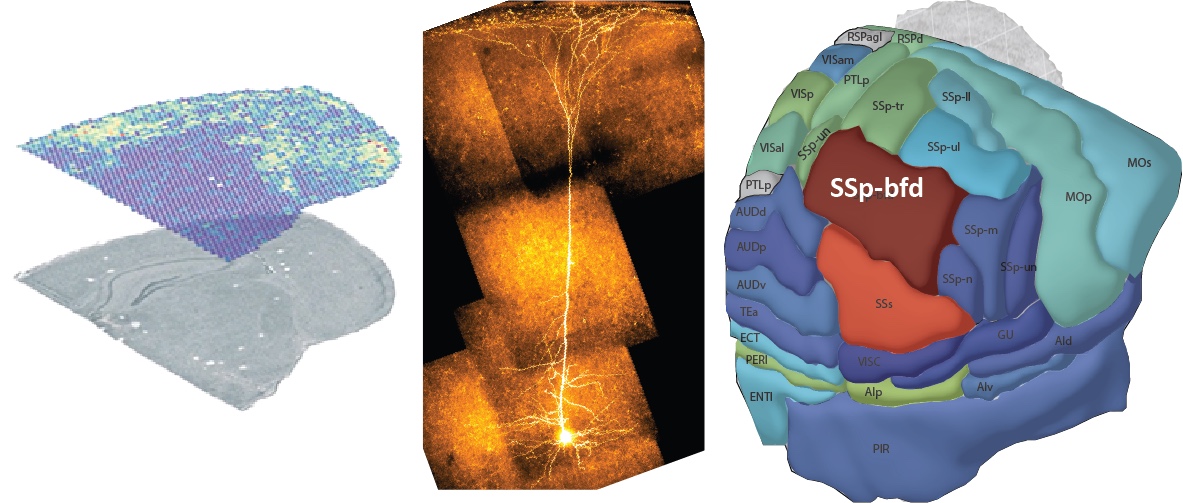
In the second round of the CRC1315, we established that memory consolidation in a µStimulation-based learning paradigm requires local mTORC1 signaling and protein synthesis in these dendrites. This provides a rare opportunity to study the molecular basis of memory at a defined subcellular site in a well-controlled behavioral setting. In this third phase, we will refine the µStim task by introducing parameter-dependent reward structures to pinpoint when and where mTORC1 activity is needed. The refinement of the µStim task will be one in collaboration with the A04 project. We will also use TRAP2-based activity marking and enriched environment paradigms to identify and label neurons involved in memory traces. At the subcellular level, we will investigate how local protein synthesis affects dendritic structure and function. Specifically, we will study how lysosome positioning, Wnt signaling, and cytoskeletal remodeling interact with mTORC1 at shaft synapses to support synaptic clustering and dendritic excitability. Techniques will include live imaging, correlative electron microscopy, and RiboTag profiling to identify newly synthesized proteins. Together, these experiments will help uncover how memory-related signals are integrated and stabilized at the level of individual dendrites.
Image: Courtesy of A10 members
Graphical Abstract
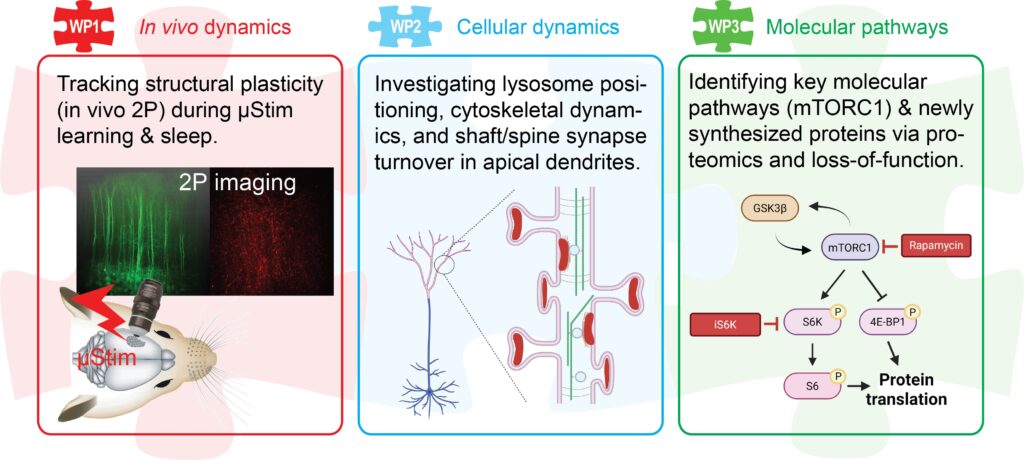
Graphical abstract: Using µStim-based learning, project A10 explores how local mTORC1 signaling, lysosome positioning, and cytoskeletal remodeling contribute to memory consolidation at the level of tuft dendrites in the neocortex.
Principal Investigators
-
Prof Dr Marina Mikhaylova
Humboldt-Universität zu Berlin
Head Optobiology
-
Prof Dr Volker Haucke
Leibniz-Forschungsinstitut für Molekulare Pharmakologie
Director Liebniz-FMP
-
Prof Matthew Larkum PhD
Humboldt-Universität zu Berlin
Spokesperson, Head Larkum Lab
-
Dr Matthias Broser
Humboldt-Universität zu Berlin
A03/A10 Associate Postdoc AG Mikhaylova (C01 Alumnus SFB1315-1)
-
Yuhao Han
Humboldt-Universität zu Berlin
A03/A10 Associated Postdoc AG Mikhaylova
-
Dr Marin Boutonnet
Humboldt-Universität zu Berlin
A10 Associated Postdoc AG Mikhaylova
-
Kinga Konkel
Freie Universität Berlin
A10 PhD (AG Haucke)
-
Alexander Biermeier
Humboldt-Universität zu Berlin
A10 PhD (AG Mikhaylova)
-
Mik Schutte
Humboldt-Universität zu Berlin
A10 PhD (AG Larkum)
-
Yannes Popp
Humboldt-Universität zu Berlin
Associated PhD AG Mikhaylova
-
Dr Gaga Kochlamazashvili
Leibniz-Forschungsinstitut für Molekulare Pharmakologie
-
Dr Julia Bär
Humboldt-Universität zu Berlin
Associate Postdoc (AG Mikhaylova)
-
Eduardo Maristany
Humboldt-Universität zu Berlin
A04/A10 Associated PhD
-
Jiameng Wu
Humboldt-Universität zu Berlin
A10 Associate PhD (Alumna)
Publications
Efficient axonal transport of endolysosomes relies on the balanced ratio of microtubule tyrosination and detyrosination
Anja Konietzny, Yuhao Han, Yannes Popp, Bas van Bommel, Aditi Sharma, Philippe Delagrange, Nicolas Arbez, Marie-Jo Moutin, Leticia Peris, Marina Mikhaylova
J Cell Sci. 137 (8): jcs261737 (2024)
Non-canonical function of ADAM10 in presynaptic plasticity
Julia Bär, Tomas Fanutza, Christopher C. Reimann, Lisa Seipold, Maja Grohe, Janike Rabea Bolter, Flemming Delfs, Michael Bucher, Christine E Gee, Michaela Schweizer, Paul Saftig, Marina Mikhaylova
Cell Mol Life Sci. 81:342 (2024)
The endoplasmic reticulum puts a new spin on synaptic tagging
Anja Konietzny, Susanne Wegmann, Marina Mikhaylova
Trends Neurosci. 46(1):32-44 (2023)